
Digitize your documents the right way, and paper stops being a picture and becomes data you can search, sort, and connect to your tools. That’s the real goal.
A scan with no processing behind it is just a dead photo sitting in a folder nobody will open. Yet plenty of businesses stop right there: they scan everything, pile up the PDFs, and call the job done.
Digitize your documents means more than scanning paper
To digitize your documents is not the same thing as scanning paper. A scan produces an image. Useful digitization produces data you can search, use, and link to other tools.
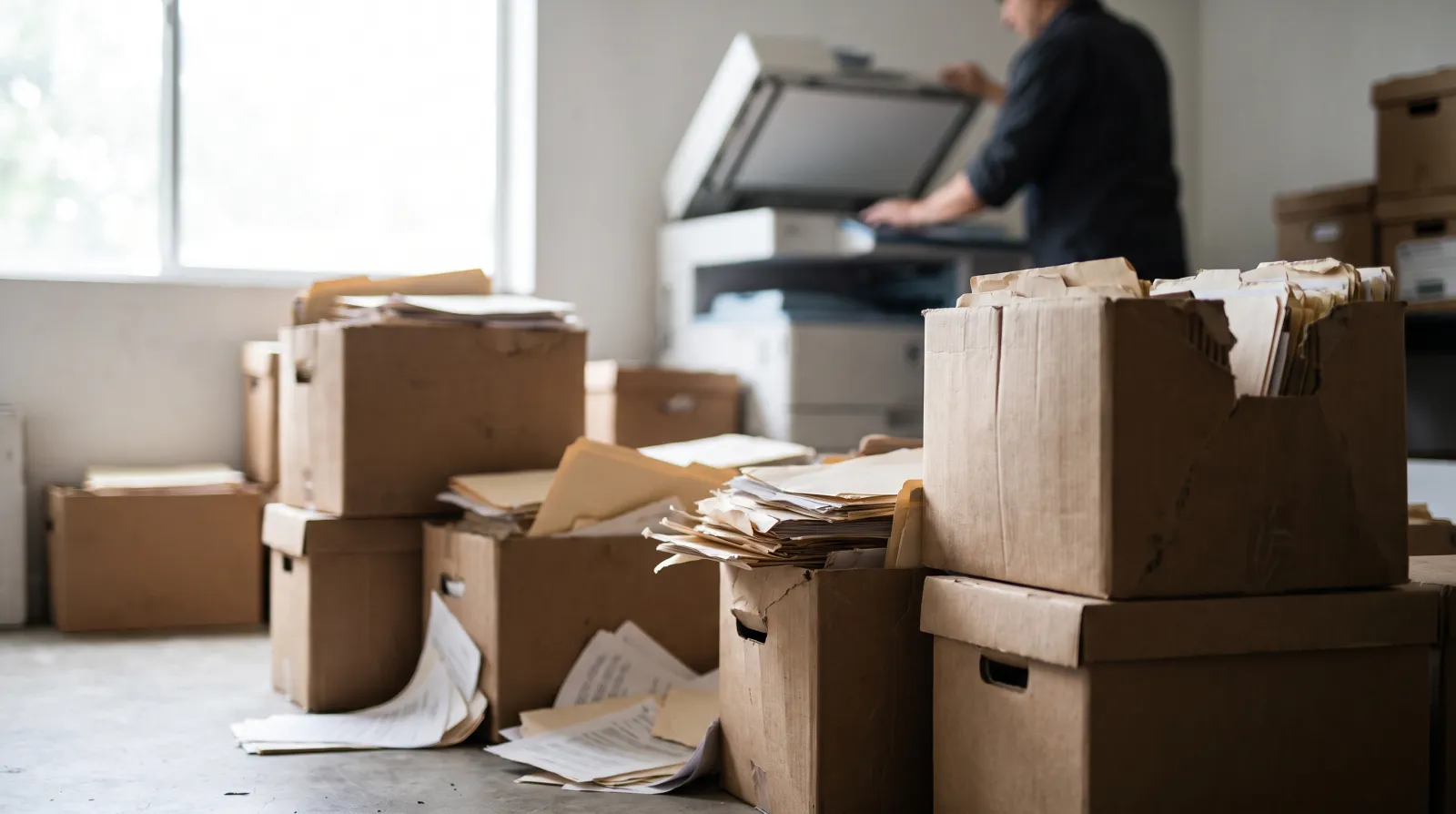
For example, one service business came to us with years of paper archives. Invoices, contracts, follow-up notes, all stacked in boxes. As a result, nobody could find anything without burning an hour on it.
So the natural instinct is to scan everything at once, at the same level of processing. But that’s exactly the mistake that makes the bill explode.
The trap of treating every document the same way
Processing thousands of documents at the same level costs a lot, without adding the same value everywhere. In fact, an active contract and an old archived invoice don’t need the same treatment.
For this business, the first quote called for detailed extraction across the entire archive: dates, amounts, names, file numbers, for every single document. Thousands of pages, all handled the exact same way.
The price followed, a bill that climbed fast for documents you might open once every five years. So before you digitize your documents in bulk, you need to ask a simple question: what do you actually use day to day?
The two-speed method to digitize your documents
The two-speed method to digitize your documents means splitting what your team uses every day from what just sits in the archive. Each category gets the treatment its real use calls for.
On one side, active documents: the ones your team opens every week to get work done. Those deserve careful processing, with key details pulled out and dropped straight into your management tools.
On the other side, the archives: rarely opened, but you still need to find them when the moment calls for it. For those, simple OCR is enough. OCR is text recognition inside an image: the word becomes searchable, without anyone having to pull out every data point by hand.
As a result, sorting in two speeds can cut the bill in half or more, without losing keyword search on the old files.
Before you scan: sort and destroy what you don’t need
Before you digitize your documents, sort them first. Some documents don’t even need to exist anymore.
The law sets specific retention periods depending on the type of document. Once that period passes, nothing requires you to keep the paper, let alone scan it. So the first step is to destroy what the law no longer requires, then sort what’s left and no longer serves a purpose.
Only then do you digitize what actually remains. Fewer documents to process, fewer pages to pay for, less noise in your search results later.
This is also the right moment to rethink what a document even is. For invoicing, for instance, the invoice becomes data, not a document: a structured file that feeds your accounting directly, instead of a PDF you open one at a time. Our article on electronic invoicing covers that shift in detail.
Test on a small batch before you run the whole system
Before you digitize your documents all at once, testing on a small batch first avoids nasty surprises. A hundred or two hundred documents is enough to judge the quality of the result.
For example, that test quickly surfaces the real problems: handwriting the system misreads, a category that’s poorly defined, a file format that won’t import into the tool you’re aiming for. Better to find that out on two hundred pages than on twenty thousand.
Then, once the test batch checks out, you adjust the method and run the rest. Google also publishes technical documentation on document text recognition, useful if you want to understand what a modern OCR engine can actually do.
What this changes, in practice
Digitize your documents with the two-speed method, and your team’s daily routine changes in concrete ways. Active documents become searchable and usable, archives stay accessible without costing a fortune.
In short, digitize your documents in a way that never costs more than the time it saves you. If you want us to look at how to sort and digitize your documents without blowing your budget, reach out.
Frequently asked questions
Sort in two speeds: active documents get careful processing, archives just need simple OCR. That way, you only pay for the effort you actually need, without losing keyword search.
OCR is text recognition inside a scanned image. It turns an old document into something searchable by keyword, even without pulling out the fine details.
No, the law sets specific retention periods. So it’s better to destroy what’s no longer required and sort the rest before you start scanning.

About the author
Terry Vilver · Co-founder of Meriaky
A computer engineer with 5 years of experience between EDF (France’s national electricity provider) and Meriaky. At EDF, he built a ticketing system that automatically assigns customer files to the right operators. For the past 2 years at Meriaky, he has been helping small business owners free themselves from repetitive tasks: client follow-up runs automatically, and they save time and money.
His LinkedIn profile
Make vs n8n: which one fits your small business
Make vs n8n comes down to your data volume and your technical comfort. Both tools connect your apps to each…

Learn to delegate without losing control
To learn to delegate means handing off a documented task to a person or a system, with a clear expected…

Organize your inbox: stop living in it
Organize your inbox by moving every message out of the main screen and into one of three destinations: to handle,…